
Age-related Macular Degeneration or AMD
Macular Degeneration, also known as Age-related Macular Degeneration (AMD), is the leading cause of legal blindness in Australia, responsible for 50% of all cases of blindness. Yet, many people are not aware of this disease and many, who have heard of AMD, do not realize the impact it could have on their vision and their lives.
What is AMD?
Macular Degeneration is currently considered to be an incurable eye disease.
To understand AMD, we must first understand the structure of the human eye.
We can compare the human eye to a camera. Just as at the back of a camera there is a film, which captures light to form pictures, at the back of the eye, there is a film-like structure called the retina, which also captures light to form images. The macula is the central and most sensitive area of the retina. When it is working properly, the macula collects highly detailed images at the centre of the field of vision (such as that required to read, drive a car, recognize faces or colors, and see objects in fine detail) and sends them up the optic nerve to the brain, which interprets them as sight. When the cells of the macula deteriorate, images are not received correctly.
AMD is caused by the deterioration of the macula.
To understand AMD, we must first understand the structure of the human eye.
We can compare the human eye to a camera. Just as at the back of a camera there is a film, which captures light to form pictures, at the back of the eye, there is a film-like structure called the retina, which also captures light to form images. The macula is the central and most sensitive area of the retina. When it is working properly, the macula collects highly detailed images at the centre of the field of vision (such as that required to read, drive a car, recognize faces or colors, and see objects in fine detail) and sends them up the optic nerve to the brain, which interprets them as sight. When the cells of the macula deteriorate, images are not received correctly.
AMD is caused by the deterioration of the macula.
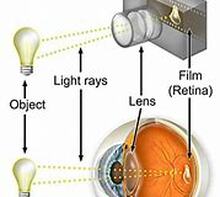
Anatomy of a Normal Human Eye compared to a Camera
In early stages, macular degeneration does not affect vision. Later, if the disease progresses, people experience wavy or blurred vision, and, if the condition continues to worsen, central vision may be completely lost. People with very advanced macular degeneration are considered legally blind. Even so, because the rest of the retina is still working, they retain their peripheral vision, which is not as clear as central vision.
Risk factors
The biggest risk factor for Macular Degeneration is age. Your risk increases as you age, and the disease is most likely to occur in those 55 and older.
Other risk factors include:
Other risk factors include:
- Genetics – People with a family history of AMD are at a higher risk.
- Race – Caucasians are more likely to develop the disease.
- Smoking – Smoking doubles the risk of AMD.
Prevention of AMD
It is possible to reduce the risk of losing sight from macular degeneration by adopting a healthy lifestyle and regularly having your eyes tested and macula checked by an eye health professional
Diet
For people with the milder form of dry AMD or, in those wishing to minimise the risk of developing AMD, in whom nutritional supplements have not been shown to be effective, a healthy diet with a high content of green leafy and other brightly coloured vegetables, fish and nuts is recommended
Nutritional supplements
The risk of developing the late effects of AMD can be reduced by nutritional supplements. The AREDS and AREDS 2 trials have shown the benefit of antioxidant and other supplements in reducing the rate of deterioration of dry AMD into wet AMD by 20-30%. However, these benefits are seen in people with moderate to severe dry AMD and not in those with milder forms. Because these nutritional supplements may be expensive, it is best to be sure that you will get some proven benefit from these supplements by seeing an eye specialist to have the severity of AMD graded.
Types of AMD
There are two types of AMD
Dry AMD
Usually AMD begins with the dry form, which results in a gradual loss of central vision but this occurs over very many years. Diet and lifestyle, including the use of an appropriate supplement, can help slow disease progression and vision loss.
In all stages of dry AMD, it is important to monitor central vision to ensure that problems, such as progression to wet AMD, can be caught early. The earliest symptom of wet AMD can be distortion of vision where straight lines can appear crooked or letters in a word look distorted. To monitor central vision, your eye specialist will recommend using an Amsler Grid.
Treatment for Dry AMD
Until recently, there was no treatment for dry AMD. However, new treatment for dry AMD is now available in the form of a gentle, non-invasive laser known as 2RT (Retinal Rejuvenation Therapy) which is suitable for selected patients with early AMD. 2RT slows or reverses some of the signs of dry AMD and can substantially reduce the risk of progression to late AMD, the stage of AMD in which some require regular eye injections.
For more information about 2RT, which can be performed in the rooms without needles and takes just minutes, click the button below:
For more information about 2RT, which can be performed in the rooms without needles and takes just minutes, click the button below:
Wet AMD
Early dry AMD can progress to the wet form, which is characterised by a sudden loss of vision and is caused by abnormal blood vessels growing under the retina.
These blood vessels can leak fluid and/or bleed to cause irreversible los of vision, if not treated immediately.
These blood vessels can leak fluid and/or bleed to cause irreversible los of vision, if not treated immediately.
Progression of AMD
There are three stages of Age-related Macular Degeneration (AMD):
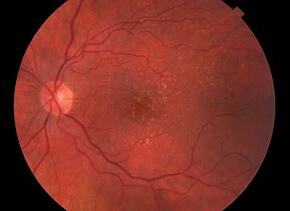
Early AMD – Most people do not experience vision loss in the early stage of AMD, which is why regular eye exams are important, particularly if you have more than one risk factor (see below). Early AMD is diagnosed by the presence of small yellow deposits beneath the retina known as drusen
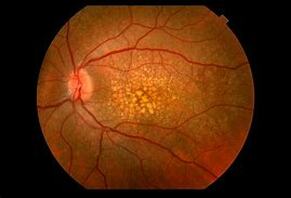
Intermediate AMD – At this stage, there may be some vision loss, but there still may not be noticeable symptoms. A comprehensive eye exam with specific tests will look for medium-sized to large drusen and/or pigment changes in the retina.
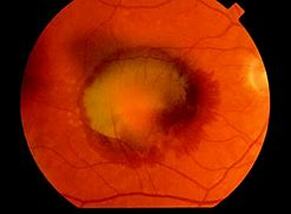
Late AMD – At this stage, vision loss has become severe due either to damage and loss of cells in the retina in a form of dry AMD known as geographic atrophy (GA) or the growth of blood vessels into the retina that leak and/ or bleed (as shown in the picture) known as wet AMD.
It is now possible to reduce the risk of progression of intermediate AMD to late AMD. Scroll down to discover how to prevent the changes shown above, with a new gentle laser treatment now available in Warrnambool or click this button:
Treatment of Dry AMD
2RT - Retinal Rejuvenation Therapy Until very recently there was no treatment for Dry AMD. However, in September 2018, new research results revealed, for the first time, a new treatment for this stage of the disease.
Retinal Rejuvenation or 2RT laser is a revolutionary new treatment for Dry AMD. 2RT is a sub threshold laser (it does not cause any visible burn or damage to the eye) delivered in a painless procedure taking just minutes in the office, not requiring injections, surgery or hospital admission. Preliminary results show a four fold reduction in the rate of progression to more advanced forms of AMD in selected patients. As such, 2RT can substantially reduce the risk of requiring monthly injections for wet macular degeneration.
Click the button for a Blog post on our News page:
Retinal Rejuvenation or 2RT laser is a revolutionary new treatment for Dry AMD. 2RT is a sub threshold laser (it does not cause any visible burn or damage to the eye) delivered in a painless procedure taking just minutes in the office, not requiring injections, surgery or hospital admission. Preliminary results show a four fold reduction in the rate of progression to more advanced forms of AMD in selected patients. As such, 2RT can substantially reduce the risk of requiring monthly injections for wet macular degeneration.
Click the button for a Blog post on our News page:
To find out about 2RT click the button below for the 2RT page:
Treatment of wet AMD
There are a number of medical treatments available for wet macular degeneration. These treatments do not cure the disease but aim to stabilise and maintain the best vision for as long as possible. Luckily, for the majority of people with wet AMD, treatment in the majority of cases can improve vision if started early enough.
A protein called Vascular Endothelial Growth Factor, or VEGF, is predominantly responsible for the growth of new blood vessels that result in rapid and severe vision loss, which if left untreated, becomes permanent.
To slow or stop this process, various drugs that block the protein, called anti-VEGF agents, may be injected into the eye.
A protein called Vascular Endothelial Growth Factor, or VEGF, is predominantly responsible for the growth of new blood vessels that result in rapid and severe vision loss, which if left untreated, becomes permanent.
To slow or stop this process, various drugs that block the protein, called anti-VEGF agents, may be injected into the eye.
Eye Injections for Wet Age-related Macular Degeneration
The introduction of sight-saving anti-VEGF eye injections has dramatically reduced the risk of loss of vision from AMD. Early diagnosis, before vision has been lost, is crucial and this requires very prompt referral. The latest imaging equipment (Optical Coherence Tomography and Fluorescein Angiography) is used, both to diagnose and follow treatment, to ensure that enough treatment is provided at the correct intervals so that useful central sight (used for reading, driving and recognising faces) is not lost.
While the idea or thought of an eye injection can be frightening, the way it is done with adequate local anaesthetic means that it is painless or only minimally uncomfortable. When weighed against the threat of permanent vision loss, the advantages of an eye injection greatly outweigh the inconvenience of it.
While the idea or thought of an eye injection can be frightening, the way it is done with adequate local anaesthetic means that it is painless or only minimally uncomfortable. When weighed against the threat of permanent vision loss, the advantages of an eye injection greatly outweigh the inconvenience of it.
For more information on AMD, click on the link below:
Any surgical or invasive procedure carries risks. Before proceeding, you should seek a second opinion from an appropriately qualified health practitioner